
A campaign with a fat ROAS might be cannibalising organic sales or propping up low-margin SKUs.1
Amazon uses ACoS2
ACoS stands for Advertising Cost of Sales. This is the percentage of your sales that you spend on advertising.
Consider this the slice of the pie (your overall sales) that you spent on advertising.
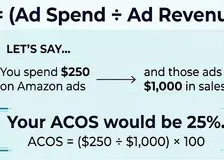
ACoS is a critical indicator for measuring Amazon PPC campaigns. Amazon ACoS assesses the effectiveness of Sponsored Product Ads. It is computed as :
ACoS = (Ad Spend/ Ad Revenue)*100
Essentially, all you’re doing is taking your ad spend and dividing it by the sales generated by the ads.
Are ACoS and RoAS related?
While the formulas may differ, ROAS and ACoS serve the same purpose: to determine whether or not your ad campaigns are profitable.
What is Good RoAS and Good ACoS?
A ‘good’ RoAS is determined by your industry or company model, which may differ from the general average. Operating expenditures, general business/account health, profit margins, and a variety of other factors all have a significant impact on RoAS. Perhaps 4:1 is a good starting point for RoAS.
What Is Amazon TACoS?3
Amazon TACoS or Total Advertising Cost of Sale is the percentage of your total revenue that is spent on ads. It measures how much dollars of total revenue (organic + paid) you generate for every dollar spent on PPC.
How to Calculate TACoS
TACoS = (Total Ad Spend / Total Revenue) x 100
Let’s say you spent $10,000 on ads, and those ads brought in ad sales worth $20,000 and organic sales worth $30,000.
Plugging it into the Amazon TACoS formula, you’ll get a TACoS of 20%.
(10,000/50,000) x 100
The reason we include organic sales is because, without ads, you won’t rank organically for any keywords. Following that logic, all organic sales are indirectly a byproduct of your ads.
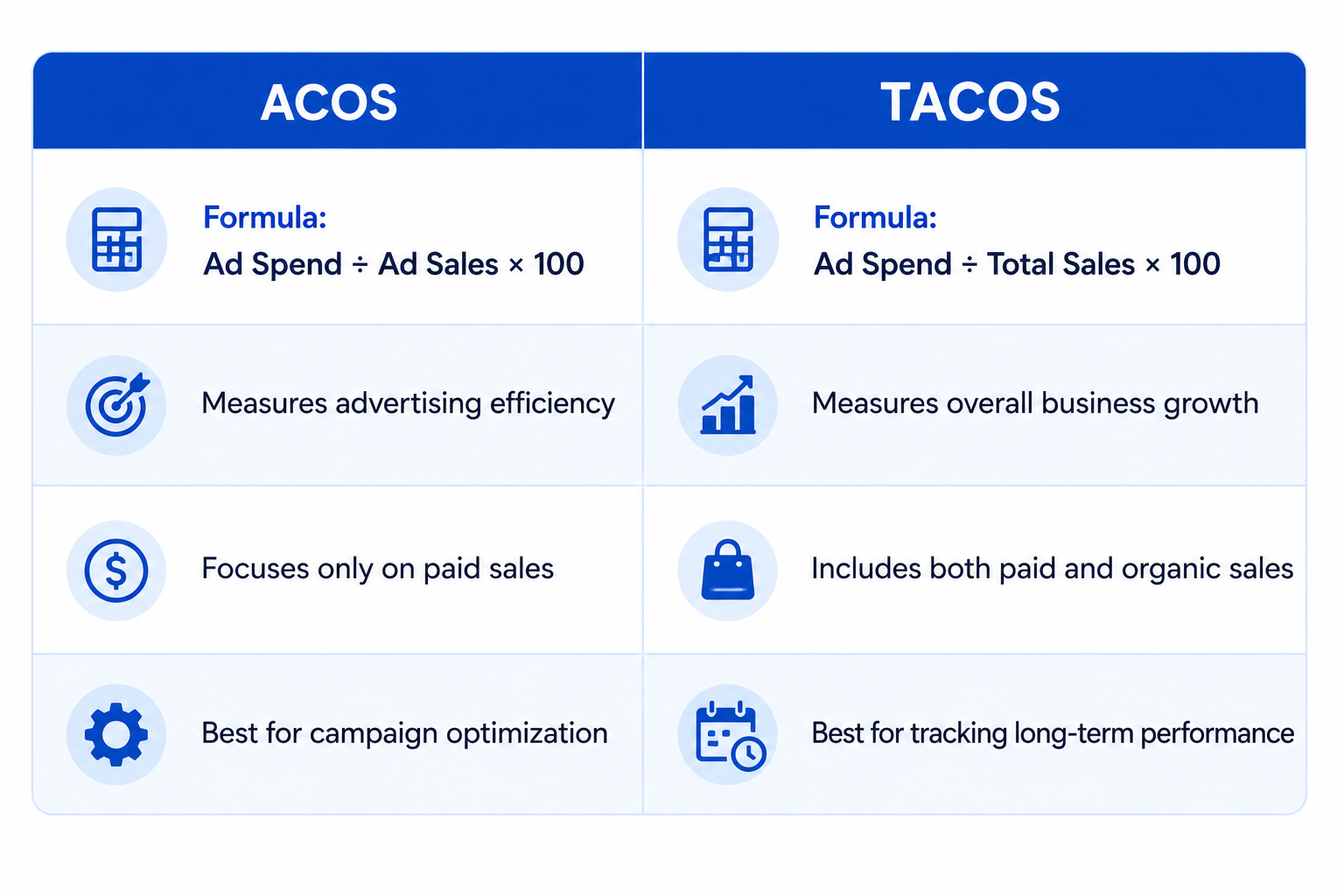
ACOS vs TACOS: What's the Difference?4
A lot of Amazon Sellers look at ACOS but they won’t have a closer look at TACOS. The problem is ACOS doesn’t give you the complete view.
ACOS shows how your campaigns perform but TACOS shows how your ads impact your overall business growth including both paid and organic sales. You have to look at both the metrics to get better understanding of your PPC campaigns
What is the product profit margin? How do we calculate it?2
The profit margin or gross profit margin for a single product is the ratio of profit to revenue. Profit can be defined as the value of a sale minus the cost of manufacturing the item sold.
Product Profit Margin% = ((Sales value – Costs Involved) / Sales value) 100
If you sell a product for $200 and your costs per unit are $120, your profit margin is ((200-120)/200)*100 = 40%.
We can calculate the break-even point for ACoS and RoAS now that we have the product profit margin.
Break-Even ACOS: The Number Every Amazon Seller Should Know4
Let’s assume two Amazon sellers, both running PPC campaigns with a 30% ACOS. One is making a good profit, while the other is losing money. The difference is clear.
It’s the Break-Even ACOS. It shows the maximum advertising cost your business can afford before your campaigns start to lose.
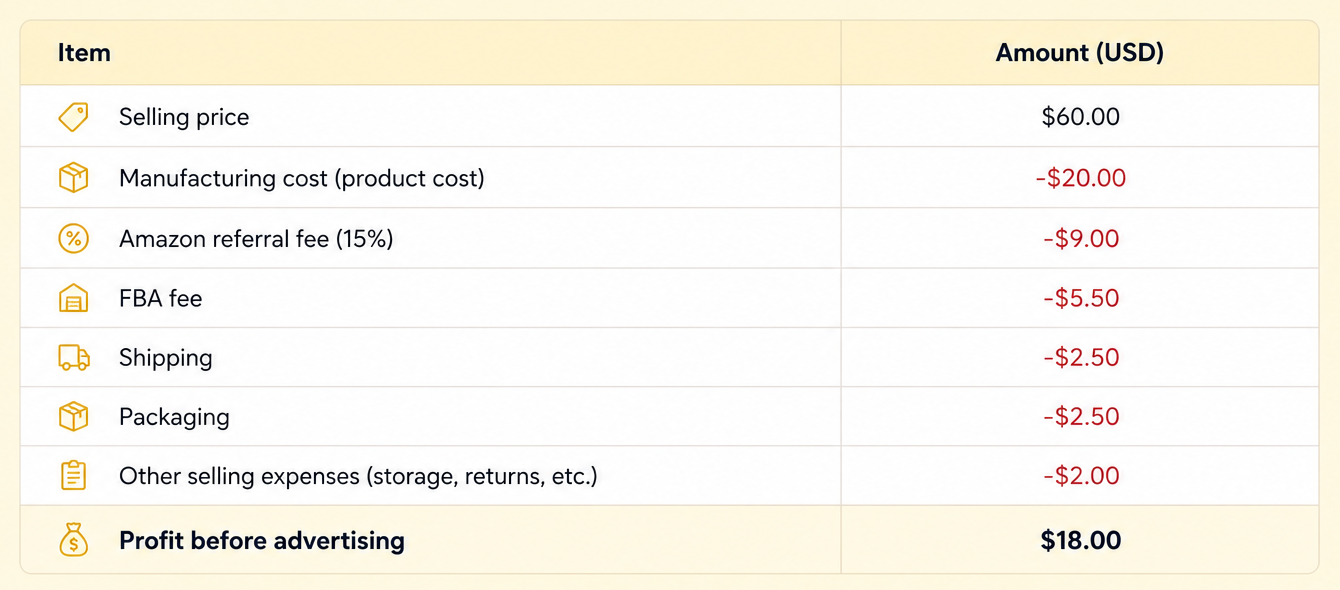
As long as your ACOS stays below this number, your ads will generate profit. Once it goes above your break-even point, it will start eating into your margins.
This is why seasoned Amazon sellers don’t rely on industry benchmarks alone.
Measure What Matters: Profit, Not Vanity ROAS1
- Analyse profit per ASIN: Ad spend, gross sales, cost, shipping, and Amazon fees down to the SKU.
- Attribute spend to incremental sales, not simply total attributed revenue.
- Use AiHello to get granular reporting: See profit, ACOS, TACOS, and net margin at the SKU level so you can cut losing campaigns and double down on scalable winners.
Framework
- Visibility: See what’s driving true profit.
- Correction: Move spend away from losers, amplify proven winners.
- Scaling: Reinforce only the campaigns and products that fuel sustainable growth.